The Auckland Harbour Bridge opens
- When
- 30 May 1959
- Where
- Waitematā Harbour · Waitematā
- Reach
- Several regions
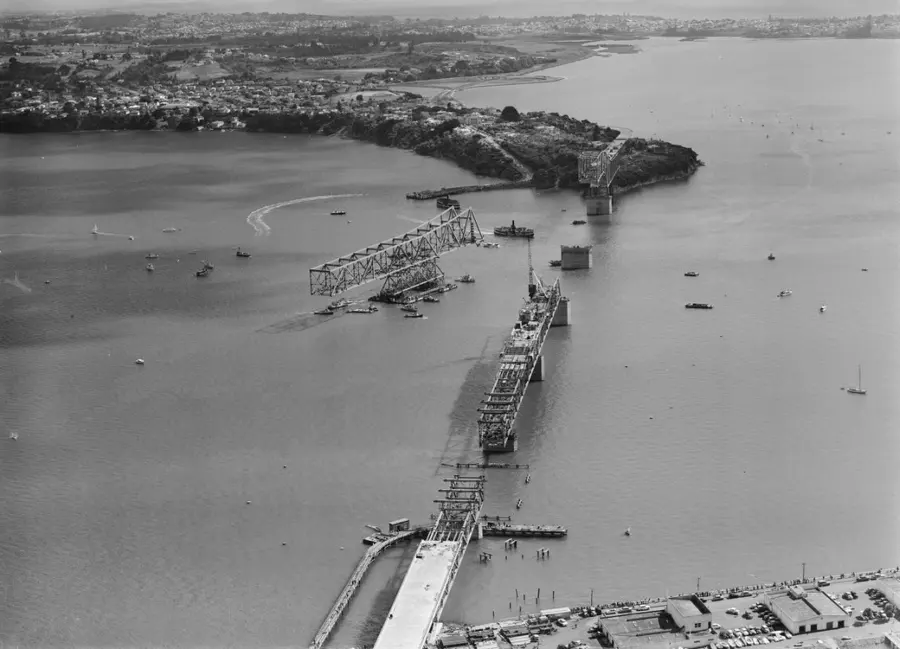
Four lanes across the Waitematā linked the city to the North Shore, and traffic quickly outgrew them.
Auckland had the busiest ferry network in the country, linking the city to its suburbs, the North Shore and the Hauraki Gulf, and families such as the Alisons and Subritzkys dominated a sometimes cut-throat trade. The Devonport Steam Ferry Company, set up in 1881, turned Devonport into a suburb, and before the bridge was built car ferries to Devonport made it the beginning of the main road north. There was talk of a bridge across the Waitematā Harbour as early as 1860 and again between the world wars. Planners and politicians gave the go-ahead only in 1946, when they made a bridge central to a new motorway system they believed would solve Auckland's transport problems. The Auckland Harbour Bridge Authority was set up in 1950 to raise funds and organise construction, and reclamation at Westhaven, at the southern end, began in 1951.
In October 1954 Dorman Long, which had built the Sydney Harbour Bridge, and the Cleveland Bridge & Engineering Company were contracted to build the bridge, and Te Ara dates construction from 1955 to 1959. Designed by Freeman Fox and Partners, it had a 'coat-hanger' shape, with steel lattice girders above the road on the 243-metre main span. The bridge rises 43 metres above the sea so that ships could reach the Chelsea Sugar Refinery to the west. Workers prepared the foundations of the reinforced concrete piers 33 metres below sea level. One span, 176 metres long and weighing 1,000 tonnes, was floated into place 'pick-a-back' on top of another. The bridge used 5,670 tonnes of steel, 17,160 cubic metres of concrete and 6,800 litres of paint. Te Ara and NZHistory's 'today in history' page give its length as 1,017 metres; another Te Ara entry gives 1,020 metres, and another NZHistory page 1,002 metres. To cut costs, a planned fifth lane and a pedestrian walkway were dropped.
Three or four men were killed in accidents during construction, and the names of three of them are on a memorial plaque beneath the bridge at the Northcote end. The Governor-General, Lord Cobham, officially opened the bridge on 30 May 1959, after an open day on which 106,000 people walked across. It was a toll bridge, and the first toll was 2s 6d (two shillings and sixpence) for a car. In its first year the bridge averaged 13,493 cars a day, a shock for planners who had predicted 8250 a day by 1965. The opening of the bridge sent most of Auckland's double-ended ferries, and all the vehicular ferries, to the ship graveyards.
The four lanes quickly proved inadequate. A Japanese company won the tender to add two lanes on each side, prefabricated in Japan and known as the 'Nippon clip-ons'. The project, which included widening the approach roads, took three years, and NZHistory dates the opening of the enlarged bridge to 23 September 1969. The clip-ons were pioneering technology at the time, but 15 years later fatigue was found in the welds of their splice joints and several thousand joints had to be replaced. Tolls were charged until 1984. Traffic kept growing, from an average of 80,000 vehicles a day in 1970 to 165,000 by 2000, and traffic jams on the bridge drove some people back to the ferries. In 1975 the Greenhithe Bridge was built as an alternative crossing of the upper Waitematā.
Te Ara calls the bridge the linchpin of Auckland's motorway system and says it opened the North Shore to new suburban development. In 1958 the trip from Birkdale to the city took 40 minutes; in 1960 it took just over 15. Cheap housing subdivisions transformed Birkdale and Beach Haven, and Takapuna gained city status after the bridge opened. Te Ara also links the bridge and motorways to a rise in car numbers, a fall in public transport use and chronic traffic congestion. Writing for NZHistory's 'A history of New Zealand in 100 places', Gavin McLean judged that the bridge's real legacy is the vast suburban sprawl on the North Shore.
Make a poster of your own family’s story, alongside the history they lived through. Create your own poster
Regions affected
Sources
Written for this project from these references rather than copied from them. Follow a link to read the full account, or to check this one against the original.
- Auckland harbour bridge opens
- 1959 – key events
- Auckland Harbour Bridge – A history of New Zealand in 100 places
- Bridges and tunnels – Notable bridges
- Auckland places – Waitematā Harbour
- Auckland places – The North Shore
- Auckland region – Expansion: 1941–1979
- Ferries – Harbour, river and lake ferries
- Communications (1966 Encyclopaedia of New Zealand)
- Auckland Harbour Bridge
Related
The 1951 waterfront dispute
Lockout and strike ran for 151 days. Emergency regulations made it a crime even to give food to a watersider’s children.
Wellington waterfrontDecimal currency day
Pounds, shillings and pence became dollars and cents, promoted by a cartoon character called Mr Dollar.
Rogernomics — the economy is deregulated
A Labour government floated the dollar, removed farm subsidies and tariffs, and sold state assets in a radical programme of market liberalisation.
Depression riots
Unemployed relief workers smashed and looted shops down Queen Street, after earlier trouble in Dunedin. Wellington had its own riot in May.
Queen Street, Auckland