The Ōtira tunnel pierces the Southern Alps
- When
- 4 August 1923
- Where
- Ōtira
- Reach
- Several regions
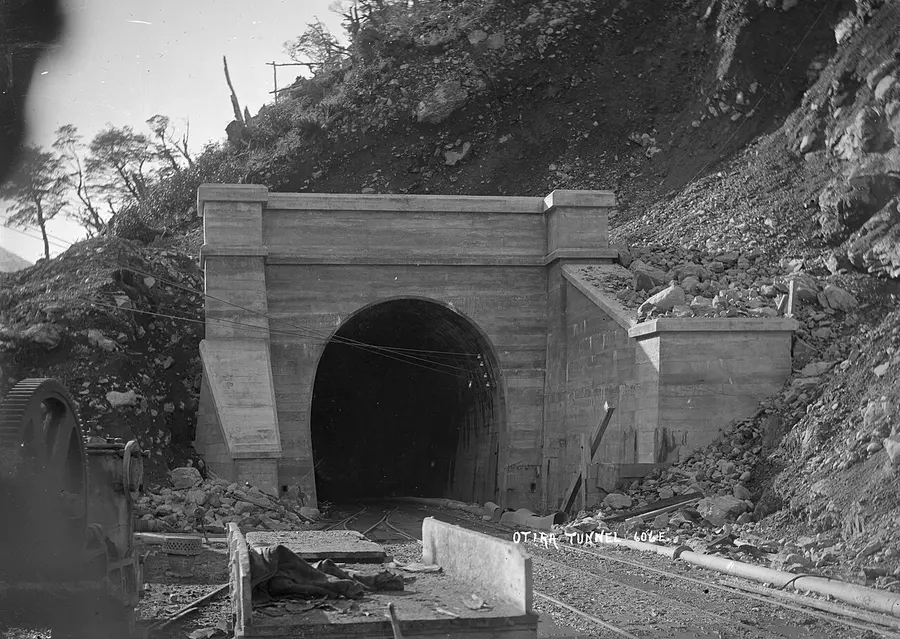
An 8.5 km tunnel under Arthur’s Pass completed the transalpine railway between Christchurch and Greymouth, and was then the longest tunnel outside the Alps.
Arthur Dobson crossed the pass over the Southern Alps that now bears his name in 1864, and a road over it to the West Coast goldfields was opened on 20 March 1866. Horse-drawn coaches kept crossing Arthur's Pass until the railway tunnel opened in 1923. In 1884 Edward and Arthur Dobson, having surveyed a railway line through the Southern Alps that took in what they called '75 miles of the most difficult country in New Zealand', launched the Midland Railway Company with other partners. Te Ara's history of railways dates the New Zealand Midland Railway Company, formed in London, to 1886 and calls it the biggest failure among private rail ventures. By 1894 it had completed 120 kilometres at a cost of £1.3 million, and the following year the government took over the struggling project, prompting legal disputes and further delays. The West Coast section reached Ōtira in 1900, but it took another 14 years for the Canterbury section to reach Arthur's Pass.
William Hall-Jones, minister for public works from 1896 to 1908, is credited in his Te Ara biography with responsibility for the eventual construction of the Ōtira tunnel. Tenders for a long tunnel through the Southern Alps to Arthur's Pass, 737 metres above sea level, were called in 1907. Te Ara says the contract was let to John McLean and Sons that year for almost £600,000; NZHistory says the firm began work in 1908. The project was plagued by engineering problems, extreme weather and labour shortages. Ōtira grew around the works, with huts for single men and bungalows for families, and the Arthur's Pass township developed from around 1908 as a construction camp for the tunnel. After five years of technical difficulties and labour conflicts the tunnel was only half done, and the firm petitioned to be relieved of the contract. In 1912 the Public Works Department took over.
The last stick of dynamite was fired in August 1918. When the two ends were joined that year, the surveyors' centre lines were less than 30 millimetres apart, which NZHistory calls impressive accuracy for the era. The 1966 Encyclopaedia of New Zealand says the tunnel was finished in 1921, but it did not open until 4 August 1923, when it completed the transalpine railway between Christchurch and Greymouth. Te Ara gives its length as 8,529 metres. It is a single-track tunnel 15 feet 6 inches (4.7 metres) high and 15 feet (4.6 metres) wide, and it slopes steeply from the Arthur's Pass end down to Ōtira, a gradient of 1 in 33. At the time it was the longest tunnel in the world outside the Alps, where there were six longer, making it the seventh-longest in the world. The Midland line had 17 tunnels when it was completed.
Electric propulsion was seen as ideal for tunnels because it avoided the smoke from steam locomotives. The 14-kilometre section through the Ōtira tunnel became New Zealand's first electrified railway, opened in 1923. Because of the tunnel's length and steep gradient, electric locomotives hauled trains through it until 1997, when the line switched to diesel. The 1966 Encyclopaedia judged that the tunnel had possibly had a greater influence than any other single factor on the development of the West Coast. It connected the region to the national rail network and allowed West Coast coal and timber to be brought east. Since then the line has mainly carried raw or partly processed materials out of the West Coast. In the 2000s its main cargo was coal from the Buller and Grey coalfields, railed to the port of Lyttelton for export, along with cement from Westport and milk powder from Hokitika.
The population of Ōtira declined after the tunnel opened, but the settlement remained a base for railway maintenance until 1999, when the railways sold the remaining houses. By the 2010s only a few dozen residents remained, and the locality is mainly a base for tramping and mountaineering. At Arthur's Pass, some of the iron huts from the construction camp survive as holiday homes. The Midland company's plan to link Canterbury with Nelson as well as the West Coast was never fully realised: work on the route between Īnangahua and Nelson was abandoned in 1931, leaving the Nelson region cut off from New Zealand's rail network.
Make a poster of your own family’s story, alongside the history they lived through. Create your own poster
Regions affected
Sources
Written for this project from these references rather than copied from them. Follow a link to read the full account, or to check this one against the original.
- Rail tunnel pierces the Southern Alps
- Ōtira tunnel opening
- Bridges and tunnels – Rail tunnels
- Bridges and tunnels – Building bridges and tunnels
- Railways – Private rail lines
- Railways – Diesel and electric trains
- West Coast region – Transport and communication
- Canterbury places – Porters Pass to Arthur’s Pass
- West Coast places – Taramakau valley
- Ōtira township
- Dobson, Arthur Dudley and Dobson, Edward
- Hall-Jones, William
- Tunnels, Rail and Road (1966 Encyclopaedia of New Zealand)
- Construction Problems (1966 Encyclopaedia of New Zealand)
Related
The 1951 waterfront dispute
Lockout and strike ran for 151 days. Emergency regulations made it a crime even to give food to a watersider’s children.
Wellington waterfrontRogernomics — the economy is deregulated
A Labour government floated the dollar, removed farm subsidies and tariffs, and sold state assets in a radical programme of market liberalisation.
Depression riots
Unemployed relief workers smashed and looted shops down Queen Street, after earlier trouble in Dunedin. Wellington had its own riot in May.
Queen Street, AucklandThe Great Strike
Watersiders and miners struck around the country; the government enrolled mounted special constables — farmers and farm workers on horseback — who took back the wharves for strike-breakers.
Wellington waterfront