The Save Manapōuri petition
- When
- 1970–1972
- Where
- Lake Manapōuri · Manapōuri
- Reach
- Nationwide
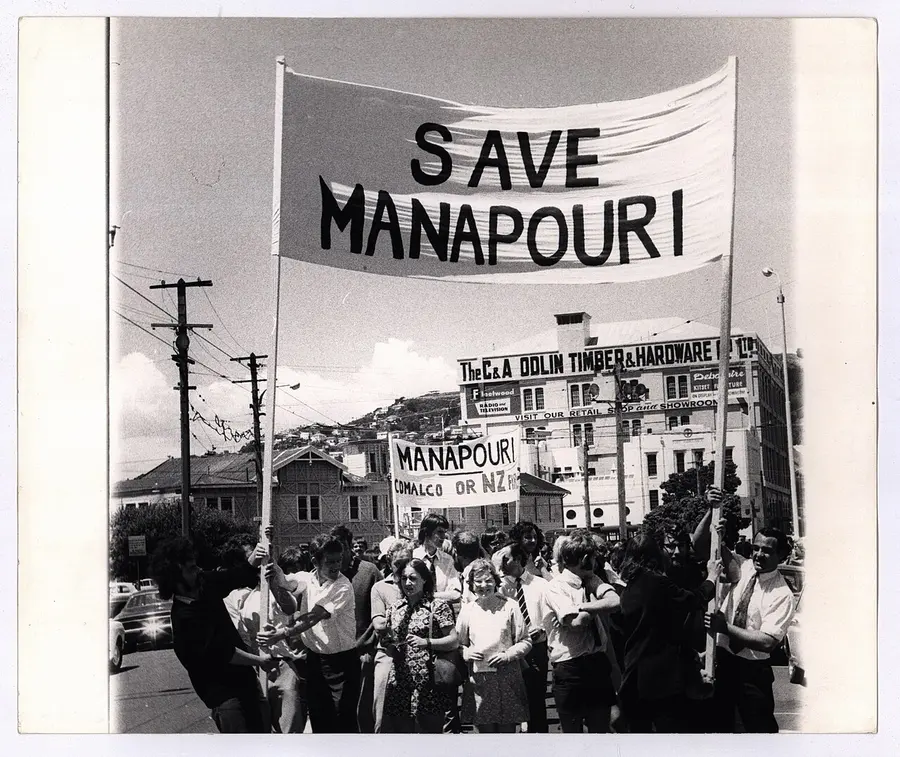
A petition of more than 260,000 signatures against raising Lake Manapōuri for a power scheme became the largest in the country’s history to that point.
The hydroelectric potential of Lake Manapōuri, in Fiordland National Park, had long been recognised, but using it would mean building a dam and raising the level of the lake. After the Second World War the government's interest in diversifying the economy made an aluminium industry attractive, and a smelter needed a reliable source of cheap and abundant electricity. In 1960 the government reached agreement for an aluminium smelter at Bluff: Te Ara's history of hydroelectricity describes a contract with Comalco giving it the right to use Manapōuri power for 99 years, while its account of the aluminium industry names the Australian firm Consolidated Zinc. When Consolidated Zinc announced in 1963 that it could not afford to build the power station, the government took on the project itself. The powerhouse was built deep underground, with a long tailrace tunnel, and 18 men died during its construction. The smelter at Tīwai Point, near Bluff, opened in 1971. To make sure of the smelter's supply, the government proposed to raise the water level of Lake Manapōuri, and the plan attracted considerable opposition from the later 1960s.
The Save Manapōuri campaign was launched at a public meeting in Invercargill in October 1969 and soon had branches all over the country. Many New Zealanders opposed the scheme because of its ecological impact, and public anger was fuelled by suspicion about secret provisions in the agreement with the company. Sources differ on how far the lake was to rise: NZHistory gives 8 metres, Alan Mark's biography of the campaign leader Ron McLean on Te Ara gives up to 11 metres, and the writer Neville Peat, quoted on Wikipedia, put it at as much as 30 metres. It was later revealed that Lake Te Anau would also be seriously affected. McLean, a Southland farmer, was president of the national campaign throughout its existence. He helped set up most of its 19 regional committees and addressed numerous public meetings around the country.
In May 1970 the campaign presented its petition to Parliament. The petition carried 264,907 signatures, nearly 10 per cent of the population. It was the largest petition New Zealand had seen to that point. A photograph from 22 May 1970 shows two Royal Forest and Bird Protection Society staff supporting a 1.5-metre pile of boxes containing the petition. That year the government published the Report of the Cabinet Committee on Lake Manapouri, an unusual step taken in response to widespread concern about the environmental impact of raising the lake. The Dominion newspaper named McLean its Man of the Year for 1970, saying he had 'demonstrated the power of ordinary people when they find something is worth fighting for'.
Manapōuri became an issue in the 1972 general election, and Labour promised in its manifesto not to change the level of the lake. After Labour won, Norman Kirk's government honoured the pledge and passed legislation protecting the lake's level. In February 1973 the minister for the environment, Joe Walding, appointed six founding Guardians of Lakes Manapōuri and Te Anau to oversee the management of the lakes. All six had been prominent leaders of the campaign, McLean among them. The power station, completed in 1971, kept running, but the lake's level was not raised. In the late 1990s a second tailrace tunnel was bored to increase the station's power output.
NZHistory describes the opposition to the scheme as New Zealand's first mass environmental movement. In Simon Nathan's account on Te Ara, it was the first time a major development scheme had been successfully opposed on environmental grounds, and it showed what could be achieved when public opinion was mobilised. Te Ara's history of hydroelectricity calls the controversy a benchmark against which public involvement in environmental issues would be measured, and its account of the aluminium industry describes saving the lake as the largest conservation issue in New Zealand's history. Alan Mark, himself one of the original Guardians, wrote that the campaign has come to be recognised as the major milestone in the country's move from the pioneering era of resource exploitation to the sustainable management of natural and physical resources.
Make a poster of your own family’s story, alongside the history they lived through. Create your own poster
Regions affected
Sources
Written for this project from these references rather than copied from them. Follow a link to read the full account, or to check this one against the original.
- ‘Save Manapouri’ petition
- 1969 – key events
- 1970 – key events
- Southland region – Transport, power and other advances
- Conservation – a history – Environmental activism, 1966–1987
- Hydroelectricity – Hydro and the environment
- Pulp and paper, aluminium and steel industries – Aluminium
- Public protest – Letter writing, petitions, meetings and rallies
- Cabinet government – Cabinet procedure
- McLean, Ronald James
- Save Manapouri campaign
Related
Ngā Tamatoa formed
A group of young urban Māori activists, many university-educated, began confronting the state over te reo, the Treaty and racism — loudly and publicly.
AucklandThe Māori language petition
Te petihana reo Māori
Ngā Tamatoa and Te Reo Māori Society delivered a 30,000-signature petition asking for te reo to be taught in schools. The date is now Māori Language Day.
Parliament, WellingtonNo Maoris, No Tour
A petition of around 160,000 signatures opposed sending an All Black team to South Africa with Māori players excluded. The tour went ahead anyway.
WellingtonThe Springbok tour
Fifty-six days that split the country. Protesters occupied the pitch at Hamilton and stopped the game; by the final test, police in riot gear fought crowds outside Eden Park.
Rugby Park, Hamilton